
Towards Trustworthy Predictions: Theory and Applications of Calibration for Modern AI
5 May 2026
Tangier, Morocco
About the workshop
This workshop focuses on calibration, the alignment between predicted probabilities and observed frequencies, which is fundamental to reliable decision-making and trust in modern AI systems. Bringing together researchers from machine learning, statistics, theoretical computer science, and applied domains such as medicine and forecasting, the workshop aims to unify perspectives on calibration theory, evaluation, and practice. Through a tutorial, invited talks, contributed posters, and interactive discussions, we seek to foster a shared understanding of calibration and to build a lasting cross-disciplinary community around trustworthy probabilistic prediction.
Call for papers
The primary aim of this workshop is to bring together researchers and practitioners working on calibration across machine learning, statistics, theoretical computer science, and applied domains. We seek to clarify foundational questions, align evaluation practices, and explore the practical implications of calibration for reliable and trustworthy AI systems.
Topics
The potential topics include, but are not limited to:
- Foundations of calibration and probabilistic forecasting
- Calibration metrics and evaluation methodologies
- Proper scoring rules and decision-theoretic perspectives
- Calibration in high-dimensional and multiclass settings
- Post-hoc and end-to-end calibration methods
- Calibration under distribution shift
- Calibration for generative models and large language models
- Calibration in high-stakes applications (e.g., medicine, forecasting, finance)
- Connections between calibration, uncertainty, and trust in AI
Submissions
🚨 Submit to our workshop and win a free registration for AISTATS 2026 🚨
We will offer a free conference registration to the best workshop submission led by a student, don't miss the opportunity to showcase your work and attend the conference for free!
We invite submissions of short papers presenting recent work on calibration. Submissions are accepted through OpenReview.
If your paper about calibration (or a closely related topic) is already accepted at the main AISTATS 2026 conference (congrats 🎉), you can register to present it at our poster session by filling the following form: main conference paper track.
Important dates
- Call for contributions: January 12, 2026
- Submission deadline:
February 20, 2026📣 Extended deadline: February 27, 2026 (Anywhere on Earth) 📣 - Notification of acceptance: March 9, 2026
- Workshop date: May 5, 2026
Format
Submissions should be formatted using the AISTATS LaTeX style. Papers are limited to 4 pages (excluding references and appendices). The review process will be double-blind. Accepted contributions will be presented as posters during the workshop. If you include an appendix, keep in mind that reviewers might not read it carefully. Your principal idea / contribution should be understandable from the main text.
Policies
Submissions under review at other venues are allowed. All accepted papers are non-archival and will be made publicly available on OpenReview.
Speakers

Peter Flach
Tutorial — Foundations of Calibration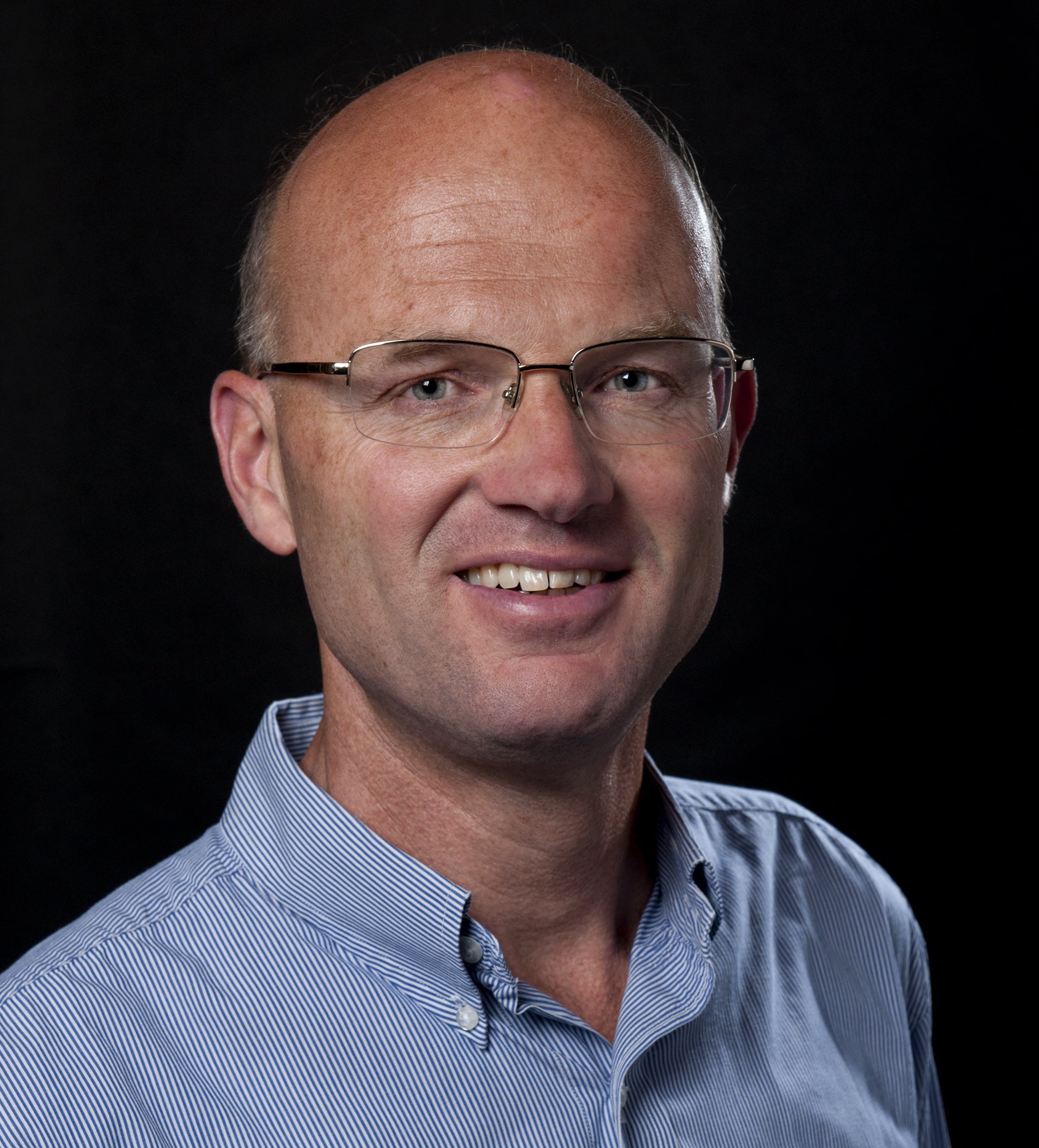
Ewout W. Steyerberg
Keynote — Trustworthy Patient-level Predictions
Johanna Ziegel
Keynote — Calibration of Probabilistic Predictions
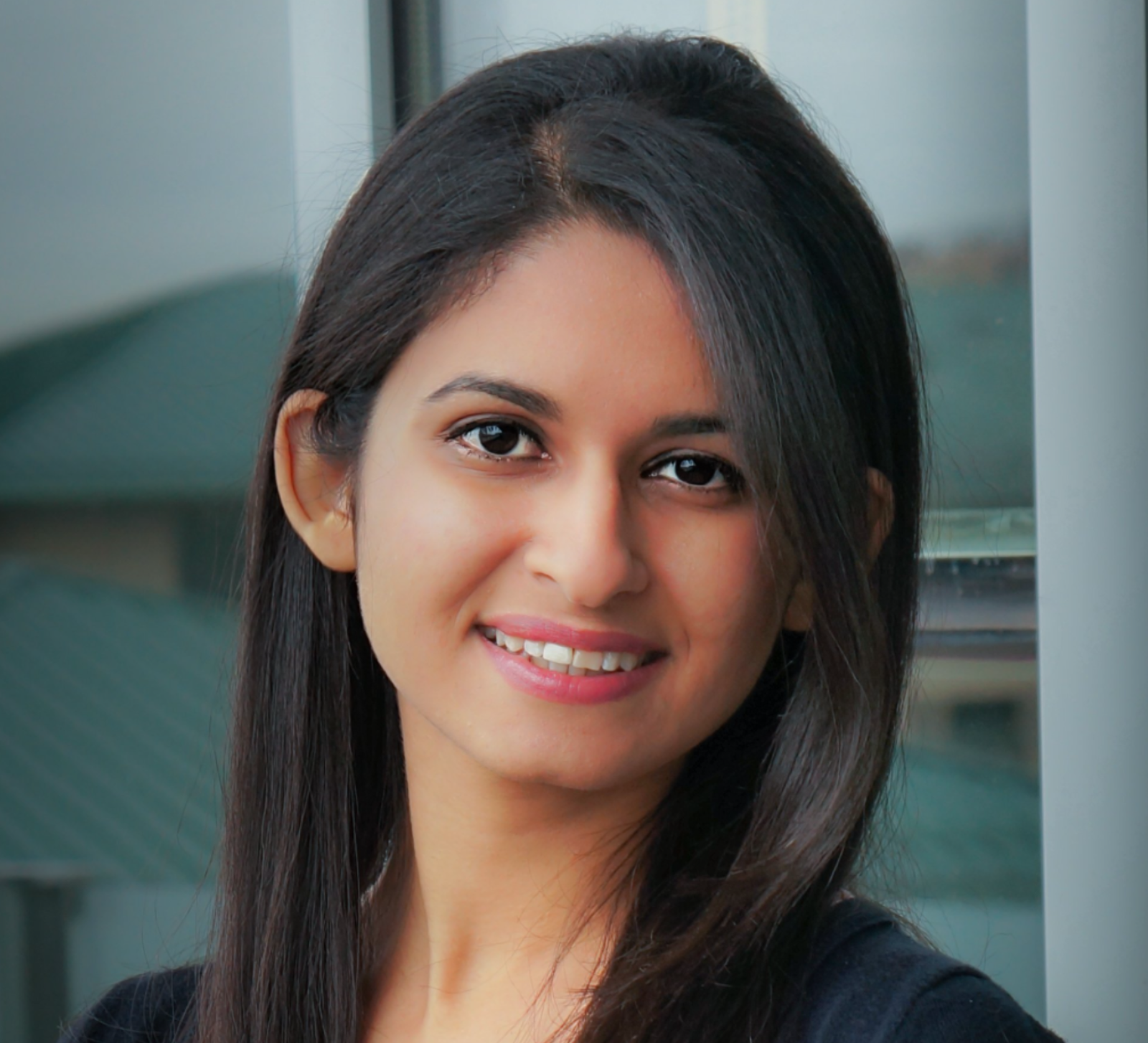
Florian Buettner
Invited Talk — Calibrated Uncertainty for Biomedical Applications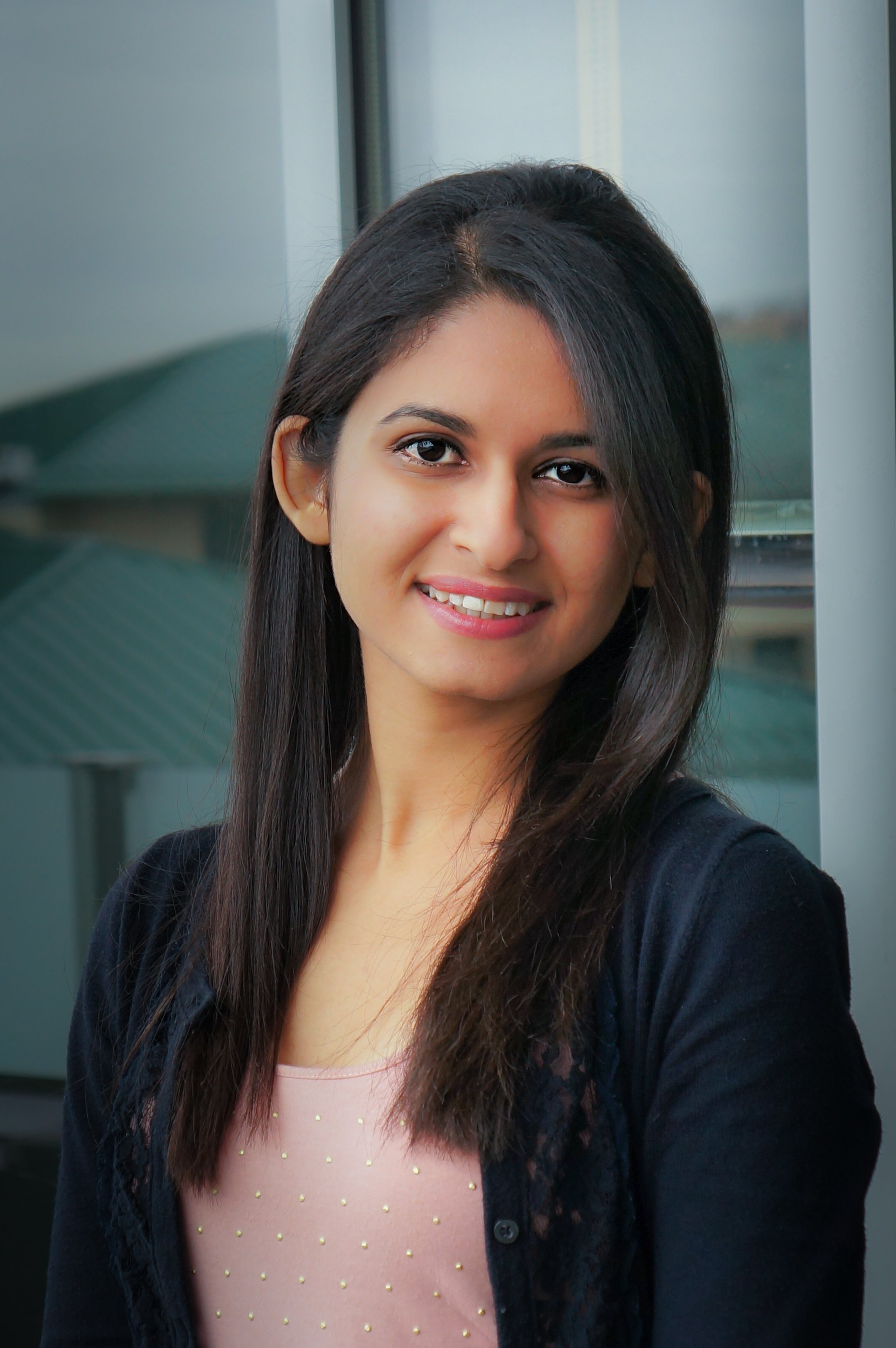
Nika Haghtalab
Invited Talk — Multi-objective LearningSchedule

Coffee Break

Keynote Ewout W. Steyerberg Slides
Towards Trustworthy Patient-level Predictions: A Multiverse of Uncertainty and Heterogeneity
Invited Talk Nika Haghtalab Slides
Multi-objective Learning: An Algorithmic Toolbox for Optimal Predictions on any Downstream Task and Loss
Lunch Break
Invited Talk Florian Buettner Slides
Leveraging Calibrated Uncertainty Estimates for Biomedical Applications
Break
Awarded Papers
Presentations by the Recipients of the Student Paper Award and Non-Student Paper Award
Poster Session
Contributed Posters Showcasing Recent Work on Calibration
Open Problems Session
Moderated Discussions on Open Challenges in Calibration
Accepted papers
Awards
-
🏆 Student Paper Award
Free Registration Award
From Entropy to Calibrated Uncertainty: Training Language Models to Reason About UncertaintyAzza Jenane, Nassim Walha, Lukas Kuhn, Florian Buettner -
🏆 Non-Student Paper Award
Calibrating the Calibration Tester: Optimal Binning and Minimax Calibration Testing for Continuous Predictive ModelsAlon Kipnis
Accepted papers
-
Interpretable Multivariate Conformal Prediction with Balanced and Jointly Calibrated Rectangular Envelopes
Nabil Alami, Rafael Izbicki, Souhaib Ben Taieb
-
Calibration Collapse Under Sycophancy Fine-Tuning: How Reward Hacking Breaks Uncertainty Quantification in LLMs
Subramanyam Sahoo
-
Full Conformal Prediction under Stochastic Non-Conformity Measure
Thanawat Sornwanee
-
SPACR: Single-Pass Adaptive Training of Uncertainty-Aware Conformal Regressors
Soundouss Messoudi, Sylvain Rousseau, Sebastien Destercke
-
On the Global and Local Calibration of Graph Neural Networks
Francesco Ferrini, Veronica Lachi, Antonio Longa, Cesare Barbera, Andrea Pugnana, Andrea Passerini, Manfred Jaeger
-
Calibrating the Calibration Tester: Optimal Binning and Minimax Calibration Testing for Continuous Predictive Models
Alon Kipnis
-
Same Graph, Different Likelihoods: Calibration of Autoregressive Graph Generators via Permutation-Equivalent Encodings
Laurits Fredsgaard, Aaron Thomas, Michael Riis Andersen, Mikkel N. Schmidt, Mahito Sugiyama
-
Multi-Class Classification with Abstention Based on Crammer–Singer Surrogate with Linear Growth Rate
Hongyu Zhang, Han Bao, Junya Honda
-
Bounding Worst-Case Calibration Error in OOD Detection Under Distribution Shift
Claudio Cesar Claros-Olivares, Austin J. Brockmeier
-
From Entropy to Calibrated Uncertainty: Training Language Models to Reason About Uncertainty
Azza Jenane, Nassim Walha, Lukas Kuhn, Florian Buettner
-
Bridging the "Predictability Desert": A Probabilistic Bias Correction Framework for AI and Dynamical Subseasonal Forecasts
Hannah Guan, Soukayna Mouatadid, Paulo Orenstein, Judah Cohen, Haiyu Dong, Genevieve Elaine Flaspohler, Alex Xijie Lu, Jonathan A. Weyn, Lester Mackey
-
Threshold Calibration: Making All Large Predicted Probabilities Trustworthy
Alexandru Lopotenco, Edgar Dobriban
-
Auditing the Performance and Calibration of Multi-Modal Large Language Models
Brendan Kennedy, Lauren Phillips, Sai Munikoti, Sameera Horawalavithana, Ian Stewart, Karl Pazdernik
-
Calibration in Context: A Case Study with Score Decompositions
Johannes Resin
-
Calibrated Multivariate Distributional Regression with Pre-Rank Regularization
Aya Laajil, Elnura Zhalieva, Naomi Desobry, Souhaib Ben Taieb
-
Where to Drop: Tuning Monte Carlo Dropout for Uncertainty Calibration in Image Classification
Lina Benyamina, Emilien Jemelen
-
Exploring Geometric Concentration for Quantifying Uncertainty in Scientific Image Caption Generation
Souradeep Chattopadhyay, Brendan Kennedy, Sai Munikoti, Karl Pazdernik, Soumik Sarkar
-
A Variational Estimator for Calibration Errors
Eugène Berta, Sacha Braun, David Holzmüller, Michael I. Jordan, Francis Bach
-
On the Calibration of Isotonic Distributional Regression
Tobias Biegert, Johannes Resin, Alexander I. Jordan, Sebastian Lerch
-
On Sharpness Diagrams
Alexander I. Jordan
-
Dirichlet Calibration Goes Local
Cesare Barbera, Lorenzo Perini, Giovanni De Toni, Andrea Passerini, Andrea Pugnana
-
Online Conformal Prediction via Universal Portfolio Algorithm
Tuo Liu, Edgar Dobriban, Francesco Orabona
-
When Synthetic Data Is Enough: Calibration for Tabular Model Ranking
Gennadii Filatov, Irina Deeva
-
When Does Calibration Matter for Safe Model Routing? Conformal Risk Control Under Imperfect Gate Calibration
Iqtedar Uddin, Mazin Khider, André Bauer
-
Demographic Calibration of Vision-Language Models for Dermatology
Sonnet Xu, Roxana Daneshjou
-
Calibrated Regression-as-Classification for Probabilistic Forecasting
Jef Jonkers, Glenn Van Wallendael, Luc Duchateau, Sofie Van Hoecke
-
Conformal Robust Optimization and Satisficing for Prescriptive Analytics with Black-Box Predictors
Lingjie Zhao, Hansheng Jiang, Wei Qi
-
Reward Calibration Beyond the Convex Hull: Depth-Based Feasibility and Regularized Exponential Tilting for Generative Models
Manoj Saravanan, Rohit Kumar Salla
-
Beyond Accuracy: Controlling Broad Error Types in Selective Classification
Emilien Jemelen, Sandrine Katsahian, Francisco Orchard, Agathe Guilloux
-
Conformal Calibration from Unlabelled Pools
Kianoosh Ashouritaklimi
-
Calibrated Multi-Level Quantile Forecasting
Tiffany Ding, Isaac Gibbs, Ryan Tibshirani
-
Towards a Venn-Abers Calibration Method for Object Detectors
Bruce Cyusa Mukama, Soundouss Messoudi, Sylvain Rousseau, Sebastien Destercke
Main conference track accepted papers
-
On the calibration of survival models with competing risks
Julie Alberge, Tristan Haugomat, Gaël Varoquaux, Judith Abécassis
-
Policy-Oriented Binary Classification: Improving (KD-)CART Final Splits for Subpopulation Targeting
Bill Wang, Zhenbang Jiao, Fangyi Wang
-
Scalable Utility-Aware multiclass calibration
Mahmoud Hegazy, Michael Jordan, Aymeric Dieuleveut
-
Brenier Isotonic Regression
Han Bao, Amirreza Eshraghi, Yutong Wang
-
Patch2Loc: Learning to Localize Patches for Unsupervised Brain Lesion Detection
Hassan Baker, Austin J. Brockmeier
-
Calibrated Predictive Lower Bounds on Time-to-Unsafe-Sampling in LLMs
Hen Davidov, Shai Feldman, Gilad Freidkin, Yaniv Romano
-
Computationally Lightweight Classifiers with Frequentist Bounds on Prediction Errors
Shreeram Murali, Cristian Rojas, Dominik Baumann
-
Structured Matrix Scaling for Multi-Class Calibration
Eugène Berta, David Holzmüller, Michael Jordan, Francis Bach
-
Panprediction: Optimal Predictions for Any Downstream Task and Loss
Sivaraman Balakrishnan, Nika Haghtalab, Daniel Hsu, Brian Lee, Eric Zhao
-
Regularizing attention scores with bootstrapping
Neo Christopher Chung, Maxim Laletin
-
Multiclass Local Calibration with the Jensen-Shannon Distance
Cesare Barbera, Lorenzo Perini, Giovanni De Toni, Andrea Passerini, Andrea Pugnana
Report
The AISTATS 2026 workshop "Towards Trustworthy Predictions: Theory and Applications of Calibration for Modern AI" was held on May 5th, 2026 at the conference venue in Tangier, Morocco. The workshop featured a tutorial, invited talks, contributed posters, and a great deal of interactive discussion. The slides and papers from the workshop are available on this website. In this report, we aim to briefly go over some of the highlights.
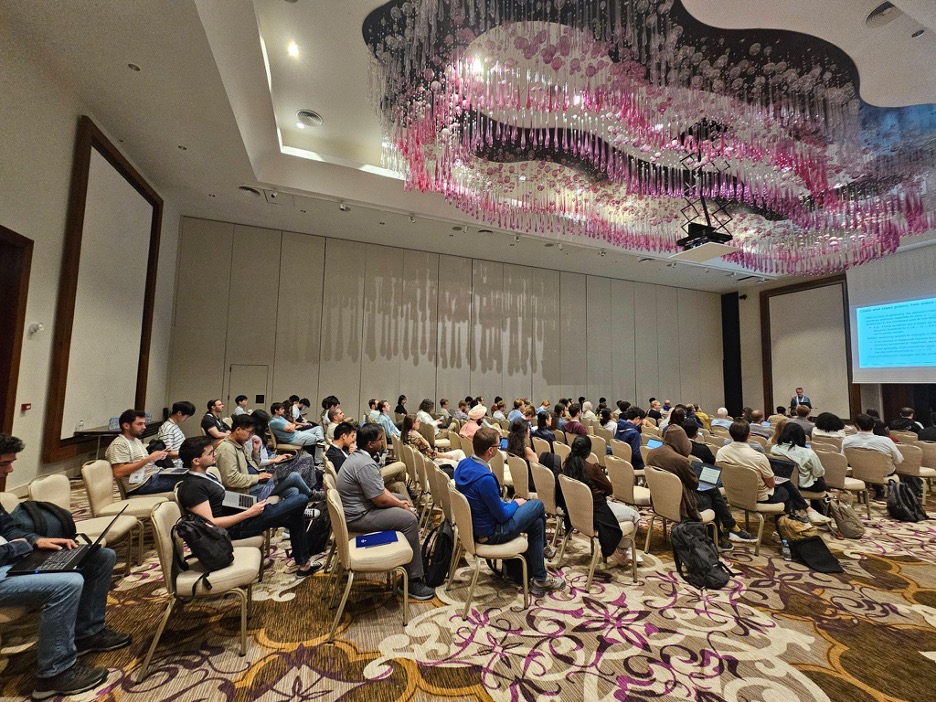
The motivation for organizing the workshop was that the topic of calibration is increasingly important, yet studied in different communities (computer science including AI and ML, statistics, economics, forecasting, etc), which have relatively limited interaction. This can make it challenging to keep up with the latest developments, and has led to instances of researchers from different communities reinventing the same concept. Therefore, the topic of calibration is an area where building a strong international community could have significant benefits. The perception of the organizers was that the community and attendees showed a good interest and turnout. The picture below shows a well-attended room of perhaps 80 (all three workshops had a capacity of 150 seats).
Tutorial
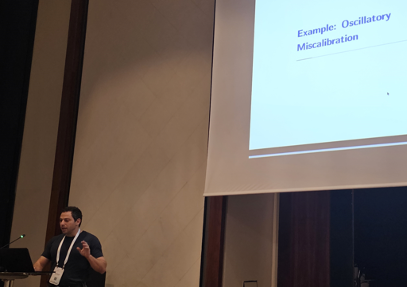
With this in mind, the first event of the workshop was a 90-minute tutorial on calibration by Peter Flach (University of Bristol), who has previously co-authored a well-known survey on calibration. Peter's talk started from the basic definition of calibration: a prediction for the probability of an event (such as a patient having heart disease) is calibrated if the fraction of people who have heart disease among those with any specific prediction—say 20%—is actually equal to the predicted fraction (i.e., 20%). Peter presented a variety of motivations for calibration, including based on utility theory and efficiency in adapting classifiers to updated class priors. The tutorial concluded with a variety of more advanced topics, Including various forms of re-calibration. For more details please see the slides.
Invited talks
The workshop then continued with several exciting talks covering various state-of-the-art research directions in calibration.
The first talk after the tutorial was by Ewout W. Steyerberg (University Medical Center Utrecht), on trustworthy patient-level predictions. Ewout focused on a central question in clinical prediction: when can we trust a number such as a patient's predicted risk? He emphasized that calibration is a crucial part of assessing trustworthiness, but also that calibration is usually evaluated at the population level, while interpreting a prediction for one individual patient is much more delicate. A recurring theme was that uncertainty in medical prediction has many sources, including finite-sample uncertainty, modeling choices, and lack of applicability to new settings. Therefore, great caution is needed when interpreting individual risk estimates, even though they can still be valuable for risk communication and shared decision-making.
Nika Haghtalab (University of California at Berkeley) then gave a talk on multi-objective learning as an algorithmic toolbox for obtaining predictions that are useful across many downstream tasks and losses. The talk connected calibration to a broader framework in which one wants a single predictor to perform well simultaneously for many groups, distributions, and loss functions. Nika explained how ideas from multi-calibration, federated learning, and distributionally robust optimization can be viewed through a common lens. She also described algorithmic ideas such as on-demand sampling and min-max optimization, and highlighted recent results showing that, in some regimes, optimizing for many tasks and losses can be nearly as statistically efficient as optimizing for just one.
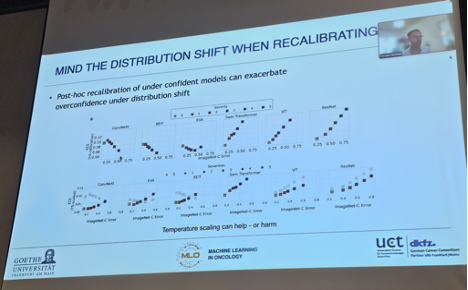
After lunch, Florian Buettner (Goethe-University Frankfurt/German Cancer Research Center (DKFZ)) talked about calibrated uncertainty estimates for biomedical AI. He emphasized that in medical settings, confident but wrong predictions can cause real harm, especially under distribution shift, where deep networks may make high-confidence errors. The talk highlighted applications in dermatology, pathology, retinal imaging, and blood cancer classification, and presented an "audit, improve, monitor" framework in which ModelAuditor identifies clinically relevant failure modes and suggests targeted fixes. Florian also connected these ideas to generative models and LLMs, discussing kernel- and spectral-entropy methods for estimating uncertainty from generated outputs.
The final talk was by Johanna Ziegel (ETH Zurich), on calibration of probabilistic predictions. Johanna started from the setting where a prediction is not a single best guess, but a full predictive distribution intended to quantify uncertainty about a future outcome. She surveyed several notions of calibration for probabilistic forecasts, including probabilistic calibration, auto-calibration, isotonic calibration, threshold calibration, quantile calibration, and marginal calibration, clarifying that these notions can differ substantially outside the binary setting. The talk then developed connections with conformal prediction and isotonic distributional regression, and discussed how conformal calibration guarantees can be used to obtain strong out-of-sample calibration guarantees. The talk concluded with applications such as temperature forecasting and length-of-stay prediction in intensive care, illustrating how these ideas can be used in realistic forecasting problems.
Paper awards
The technical program was rounded out by presentations from the recipients of the paper awards:
- 🏆 Student Paper Award From Entropy to Calibrated Uncertainty: Training Language Models to Reason About Uncertainty; by Azza Jenane, Nassim Walha, Lukas Kuhn, Florian Buettner
- 🏆 Non-Student Paper Award Calibrating the Calibration Tester: Optimal Binning and Minimax Calibration Testing for Continuous Predictive Models; by Alon Kipnis
Poster session
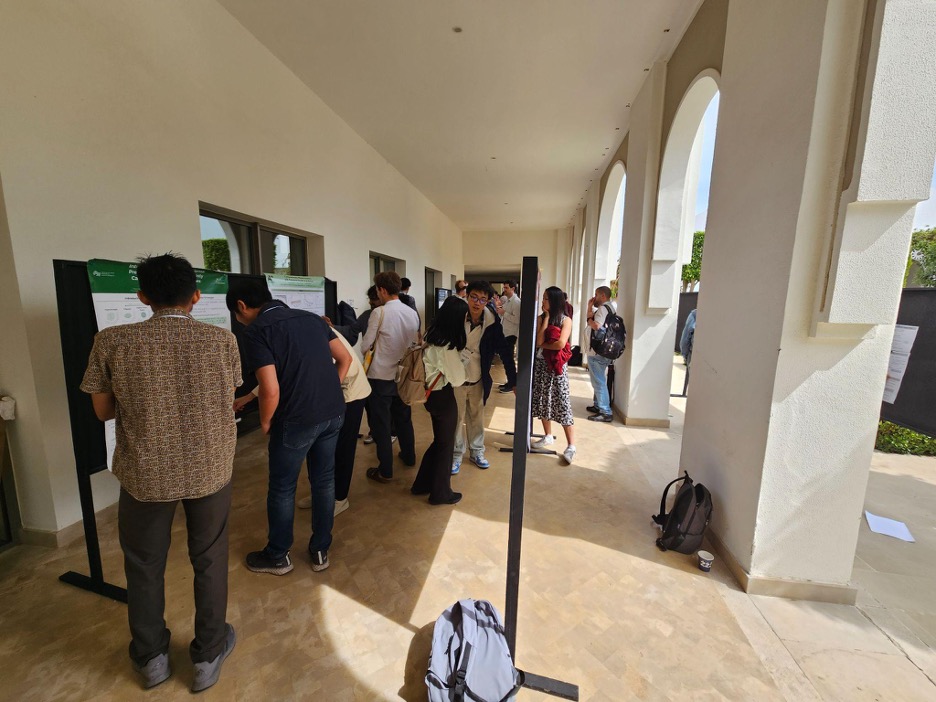
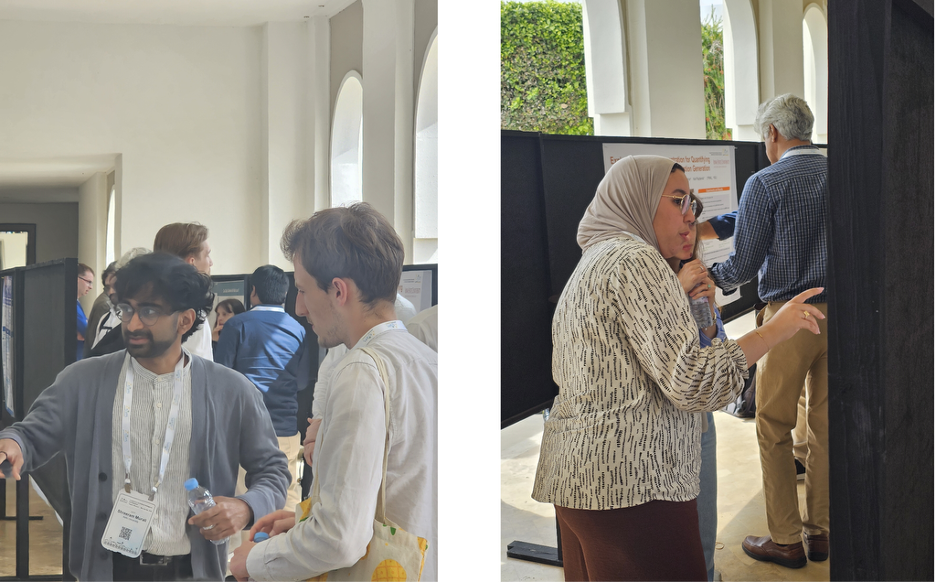
Another component of the workshop was the poster session. The workshop featured approximately 45 posters, with topics ranging from theory, methods, algorithms, and applications of calibration. The conference venue had a unique outdoor poster session with a great deal of natural sunlight, which stimulated lively discussion among the presenters and attendees.
Roundtable discussion
The workshop ended with a 45-minute roundtable discussion where speakers and attendees shared their key concerns and perspectives. Topics included:
- The importance of choosing sound evaluation metrics for calibration, and how different scenarios require different evaluation approaches beyond the popular Expected Calibration Error (ECE) — Johanna Ziegel, Sebastian Gruber
- We are better at correcting miscalibration than estimating or evaluating it, leaving room for improvement at a fundamental level — Eugene Berta
- Calibration from the perspective of algorithmic decision making captures specific forms of failure due to miscalibration, but these are still missing outside of the binary case — Nika Haghtalab
- The ECE remains popular partly because there has not been a focused demonstration of its failures — Edgar Dobriban
- Miscalibration happening despite strong predictive performance of modern ML methods surprises many; the notion of calibeating offers one answer, showing one can gain calibration without losing expertise — Souhaib Ben Taieb, Nika Haghtalab
- New and emerging research areas in AI such as automated research raise questions about how we should use probabilistic predictions going forward — Nika Haghtalab
- The community should think about fundamental limits in the area of calibration — Souhaib Ben Taieb
Looking forward
Several attendees mentioned interest in participating in or leading a community on topics related to the workshop. The organizers believe the following activities could be valuable:
- Further workshops and meetings focusing on calibration, associated with major ML conferences or independent venues such as BIRS, Oberwolfach, etc.
- Tutorials on calibration delivered at conferences and/or recorded online for improved accessibility.
- Community resources including a web repository of papers, videos, computational tools/packages, and links to events.

The organizers thank the speakers, the attendees, and the AISTATS conference organizers (workshop chairs Quentin Berthet and Claire Vernade) for their great help and support.
Organizers

Sebastian Gruber
KU Leuven
Teodora Popordanoska
KU Leuven
Yifan Wu
Microsoft Research
Eugène Berta
INRIA
Francis Bach
INRIA
Edgar Dobriban
University of PennsylvaniaTips for attendees
Conference venue
Hilton Tanger Al Houara
Km 17.5, Route de l'Aéroport, Al Houara, Tangier, 90000, Morocco
Poster printing
Participants are responsible for printing their own posters.
Poster board specifications
- Dimensions: 2.4 m x 1.2 m
- Material: 100% wood
- Fixing method: pins or command strips